
The Future of AI Deployment Is Hybrid
A practical map of where AI models can run, and why the winning designs route across all of it, not one rung.
Most teams still treat AI deployment as a binary: call the vendor's API, or self-host. That framing is already obsolete. The real question is not which one you choose, it is how you route work across a whole spectrum of options, and the teams that see this first will have a genuine edge on cost, control, and speed.
There are roughly seven ways to run an AI model, and they form a ladder. At the top, frontier vendor models, maximum convenience and power, least control over your data. At the bottom, open models you host yourself, maximum control, with more cost and effort falling on you. The colour of each rung shows the direction of the trade-off, not a score.
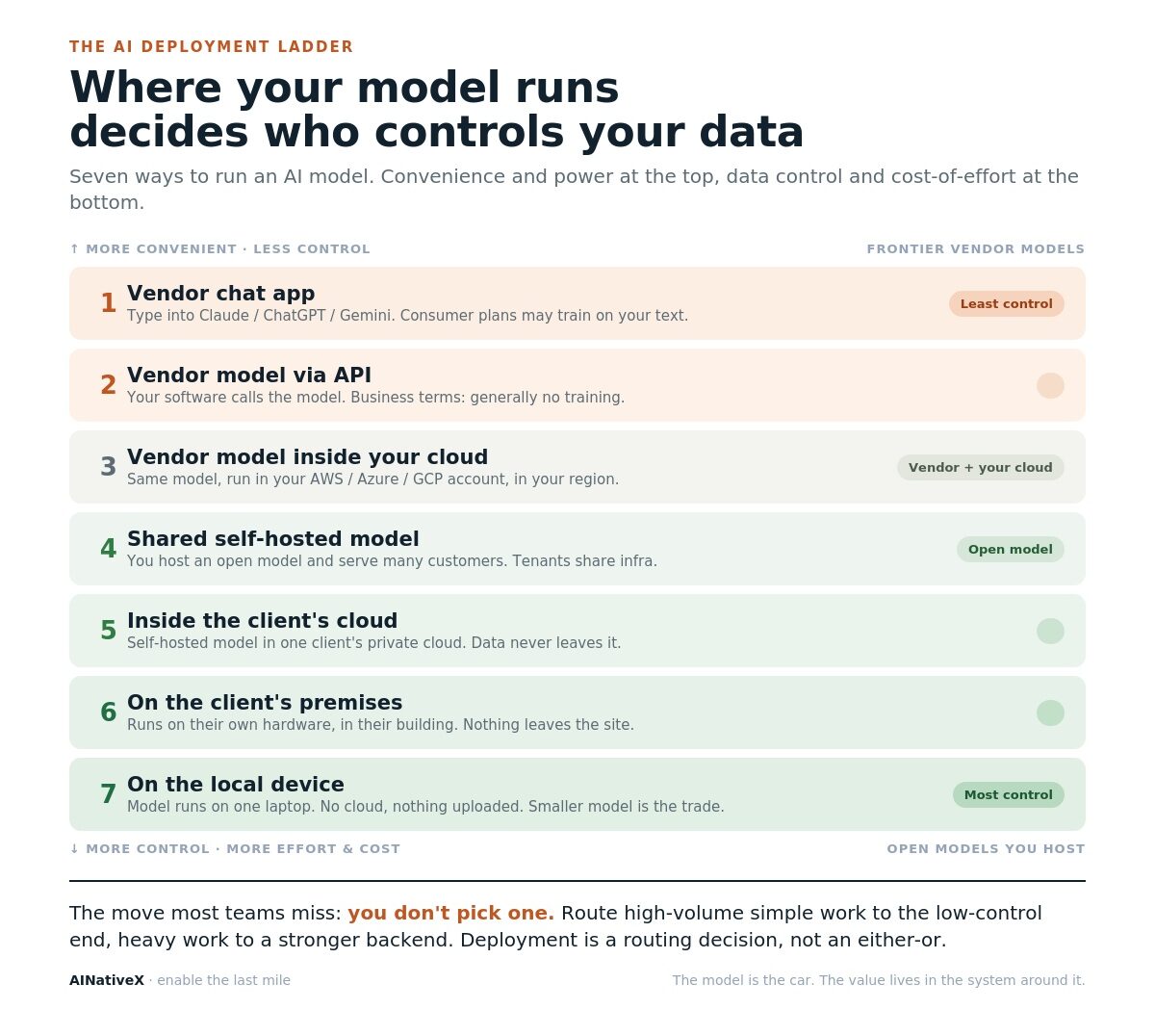
For years the debate was which rung to stand on. That is the wrong question. The future is hybrid. You do not pick a rung, you route across the ladder: high-volume, rudimentary work runs cheaply and privately at the low-control end, even on-device, while anything that needs real reasoning power is sent to a stronger model higher up. A single product spans several rungs at once, choosing per task based on cost, data sensitivity, and how much power the job actually needs.
Why hybrid is becoming the default
- Data sovereignty is tightening. More work has to stay in a specific region, cloud, or building, which pushes real workloads down the ladder and forces per-task placement decisions.
- Open models are now genuinely capable. The low-control end of the ladder is no longer a compromise. Small, on-device models are good enough to own the high-volume, routine work outright.
- The cost gap is too large to ignore. Running everything on frontier models versus routing intelligently is a difference no serious operator will leave on the table.
One subtlety that trips people up
The ladder actually mixes two questions: who owns the model, and where it runs. The top rungs use a vendor's model, the bottom rungs use an open model you host. That is why a shared self-hosted setup is not automatically more private than a vendor model running inside your own cloud. Hybrid design means reasoning about both axes at once, ownership and location, not just one. This is also, in spirit, the client-server split of an earlier computing era returning in a new form: a light, local tier for the common case, a powerful remote tier for the hard case.
The teams that win will stop asking “API or self-host,” and start designing deployment as an architecture, a hybrid routing layer that sends each task to the right rung. Within a couple of years, almost every serious deployment will be the second kind.
AINativeX · enable the last mile · the model is the car; the value lives in the system around it.